For the summer project, the brief was to either illustrate a story or write and illustrate our own story which had to be based on one of the four themes we were given to choose from. They were- Scary stories, The Outsiders, The Natural World and Non Place.
I chose to write a story because I wanted a bit more of a challenge on my hands then just to illustrate one. And I gravitated towards doing the scary story which had to be based on moral consequences.
I thought I'd be good at coming up with ideas for this one, because I have a younger sister that I feel needs to be taught a few lessons ...she is the youngest and the youngest are often said to be the most spoilt. This depends on what and how people judge what being spoilt is and obviously siblings younger and older will always have a comment on one another on how fair things are and should be. However my sister truly is spoilt and she knows it. So what do you do to shake them of their greedy ways...and this is where my imagination opened up.
I had a few ideas for a moral consequence, some were quite gruesome, but the one I wanted to draw up straight away was the idea of the spoilt girl being told she has been given three chances to change her ways or she'll start to turn into a real life size doll...with sewn on knitted eyes, mitten doll hands and feet and cotton straw like hair. And on every birthday she gets to see a glimpse of herself in the mirror of what she'd look like as the girl she once was.
I am aiming this book at children ages 5-12 as I thought the age for learning valuable lessons are at that age....and I don't think this book is too scary (it's maybe a little depressing) but its scary enough for young children and hopefully learn from it to be appreciative of the things they have, the things they would like to have and things they receive. It doesn't cost anything to say thank you!
Here are some of my sketches...
My character is called Penny in the story.
She trashes her toys and makes up that they had broke on her so that she has an excuse for getting new toys.
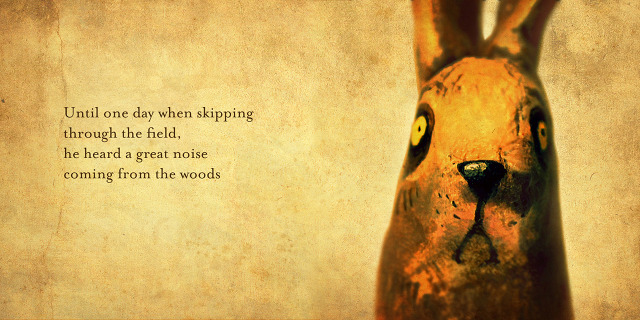
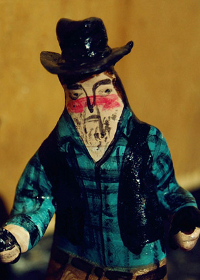
I also decided to make the charter 3D and photograph still scenes....
And by the end of the day she becomes a doll.. and on every birthday, she gets a glimpse of herself in the mirror as the girl she once was.
This project was to create a minute long animation to be played with one of the folloing documentary broadcasts on Radio 4 to chose from were-
The Style and flavour of Charlie Parker
Saxophonists Soweto Kinch and Courtney Pine discuss the origins of one of the world's most gifted sax players, Charlie Parker and how his sound defined a genre as well as a style of playing which was nothing that came before it. http://www.bbc.co.uk/programmes/p015ggx4
2. The birth of the Radio
How the industrail revolution gave rise to life changing machinary, and Guglielmo Marconi's tinkering with ''Wireless Telegraphy'' changed the world. http:// www.bbc.co.uk/programmes/p010qnhc
3. Jane Yolen's Sleeping beauty set in the Holocaust
4. "One never expects a funny person to become ill"
Margaret Rutherford discusses her mental breakdowns on in Town Today and challenges the idea that you don't expect fnny people to become ill. httpwww.bbc.co.uk/programmes/p012rzzt
I chose "One never expects a funny person to become ill'' because I felt I could be a bit simple with this and not be too detailed in movement and have a lot of things going on and happening at every second....this can be slowed down and move with the words as they come. I like David Shrigleys animations and how he tells stories, but mostly I like his black line drawings they tickle my eye, so I am in the process of puting my animation together with black line charater drawings which will be poped into a 3d set....
I have been looking at David Shrigley for inspiration..
Here are a few of David Shrigleys animations....
I have also been looking Red Nose studios...this clip is showing the process of making his sculpted characters...just simply amazing!!
This is just a little snippet of what they do but I love the ideas and the characters. it is something I would have been intersested in doing myself had I have the time..
It's a book about why we connect with things the way we do and how technology has changed the way we live since it came and now. There are many interesting facts in their which may actually get you to think about the way you live your life...it's a great read!
Ken Robinson's talk on how 'school kills creativity' has stuck with me ever since I listened to it in my first year of university. When I was in school, I could never concentrate in any of my lessons apart from drawing class and I would say that I did get educated out of creativity because I was never encouraged to do anything with my creative mind. And it's sad to think, that it's the case for a lot of talented and creative people out there. Being creative doesn't mean the only option for a of job is a book illustrator, there are lots of jobs that require creativity. Creative thinking is for some (like myself) something we need to do in order to learn better etc and for the most part of my school days I grew up believing I was stupid because I couldnt soak things up and learn things quicker the acedemic kids could. But as Robinson was saying, in education if you make a mistake, it's the worst thing you could do and that was how it was for me in school. If were all learning the same thing, why does it matter so much, how we learn it??
What if it was the other way around, where art and drama were at the top and maths and science were at the bottom...well that wouldnt be fair to all of the acedemic thinkers out there either. I agree with Ken Robinson when he say's it should be equal! That would be fair! The Scream Online Magazine Article- http://www.thescreamonline.com/ http://nasonart.com/writing/ondrawing2.html
By Norm Nason- On Drawing
When I was writing up my essay, which was about the word 'drawing' I was researching for quotes etc and came across an essay/article on 'scream online magazine', which was also about drawing...and as I read through it, there was abit about learning from failure that has stuck with me...... (which bearing in mind even though it has been written for artists, it can apply to anybody)!
Learning
from Failure
"Failure is
a necessary part of learning; one should not strive to avoid it.
Were it not for experiencing failure, we would become satisfied with
our efforts and would have no reason to progress any further. Realize
that you will never be entirely pleased with any drawing you produce.
In each attempt you will strive to accomplish something beyond the
scope of your abilities. You will fail in your attempt to some degree,
but at the same time grow as an artist. Accept the fact that it will
always be so; it will keep you humble.
You may already
have some drawing experience and this may be helpful to you. But
if not seen in the proper perspective, past experience can actually
hinder artistic development. Experienced students of art tend to
cling to old habits. There is security in this, for to try something
new
would
mean sailing into uncharted waters, becoming vulnerable to failure.
This, as I have said, can be painful and discouraging. One would
be wise to remember that failure is a necessary part of learning.
Repeat this as a mantra. Despite your previous experience or assumptions,
make a serious effort to set aside your old habits and give consideration
to new methods. Have no preconceptions or prejudices. If you cling
too strongly to past practices you run the risk of missing critical
information that might otherwise improve your ability to draw.
When learning
a new method of drawing (or any new discipline, for that matter),
you are taking the difficult path. Your attempts may feel awkward
at first, your journey tough and frustrating. Your first drawings
done in the new manner will very likely be worse than the ones you
did the old way. When this happens, stay the course. Remember that
the progressive artist is one who adheres to a methodology in which
he willingly tries new things and risks failure. Sargent did this.
So did Rembrandt. Not satisfied with mastering portraits, they each
proceeded as if they were perpetually in school, striving at every
moment to learn something new."
... What he is saying makes a lot of sense and I hope it helps others who read this too...he talks about a lot of other interesting topics in his article (on drawing) such as- Artistic Responsibility- ...
..."The artist’s
job is to confront the ordinary, muntane elements of life and—by
sheer strength of will—transform them. This only happens when
you take responsibility for understanding the character of your weaknesses.
It is only by overcoming them that you will experience artistic growth". You just need to read it and something in what he is saying..whether your a designer, illustrator, will probably pop out at you and make sense to you too!
1. ) Life is about taking a chance!
My dad often say's to me (and we have all heard this from someone lots of times before)..that..'life is about taking a chance'!...but when told this, do we actually take it in... because when a big/small opportunity does come along, how often do we just waste time thinking about whether or not to do it etc...whatever it may be!....Well I figured that for me...the more I think about whether or not to take up an opportunity, I hit upon reasons not to and thats what puts me off...I over think too much (tut) So from now on when an opportunity does come along, I'm going to skip the thinking part and just say YEAH and then there's nothing I can do about it but do it. And if it goes wrong than so be it...life goes on!
2. ) You have to fail first
Yep this makes sense to me because I do often fail things first time round, however when it comes to art, it's often that illustrators/designers think there not good enough to carry on if they failed to please previous commissioner(s) If you can over come this then you can over come anything and you no you belong in the art industry if you haven't given up! Nothing come's easy and if you want to succeed you have to show and prove to yourself that it is what you want to do and it is where you want to be...you have to fail first to appreciate the high's!!
3.) Don't be so hard on yourself
Illustrators, designers, artists...it is known that we are are own worst critiques and to have that attitude if you want to get commissioned will not get me (you) anywhere! Having confidence in yourself and what you do will show, and this puts confidence in the person who may want to commission you...the last thing they want to hear is...I'm not sure about this piece I did, it could be a lot better! I't's about believing in what you do that will allow you to feel confident in talking about your work to a potential commissioner!
1.) Ambition
My tutors and peers get together to discuss a different topic about whats going on in the illustrative industry to share are thoughts and opinions. All though this topic we discussed was about 'Ambition' and what it means to us now that we are coming to the end of our second year, heading in to our last year, level 6!- we need to start thinking about how we will fit into the industry and how we can make it happen...
We talked about whether or not the recession has an affects on illustrators getting a job, however it has been said in the guardian newspaper, that throughout Britians history, having a degree has never guaranteed you getting a job at the end regardless of the financial climate....you have to work hard to get to where you want to be.
We also talked about the collaborative's 'Lord Whitney' and pointed out all the things they have done to get to where they are now...they have done a lot of voluntary work, they are very versatile and they take risks and that is what has payed off! They have a clear vision of there goal and they work at it until they get it!!!!
This topic was on an article about 'Where is the content? Where is the comment? written by artist, illustrator and author Lawrence Zeengen.
Zeegen describes the illustration of today as being just pretty and meaningless suggesting there's nothingness about it.
He said.... "illustration has become entrenched in navel-gazing and self-authorship...obssessed with it's own craft, it has withdrawn from society's big debates to focus on the chit-chat of inner sanctum nothingness. It's time for the profession to stop pleasing itself and engage with the world outside"
Zeegen favours the work of illustrator, cartoonist and animator David Shrigley who's work is all about the content and meaning. And its obvious to see that Shrigleys work is all about the meaning because of the humorous drawings he illustrates to go with the funny controversial captions he sometimes writes at the side and this is what Zeegan prefers because its passing a comment on our society.
However I don't quite agree with Lawrence Zeegan for many reasons but for me his article was irrelavant. Yes he is entitled to his own opinion but without art of all kinds in the world, that are made to have a meaning or not... it doesn't matter, art can mean many things to one person and nothing to another, that is how art works!
3.) Authorstrator
This topic was about the differences in personal and commissioned illustration work.
And we looked at some illustrators work to see if we could tell which piece of theirs was personal and which was commissioned. Matthew Richardson said he likes his personal work compared to his commissioned and I guess that would be the case for a lot of illustrators who prefer to be able to just do exactly what they want act however for other illustrators they seemed to be able to produce better commissioned work then their personal, which shows that having a restriction and a deadline can really work in your favour.
I absolutely admire the work of illustrator, Marta Dlugolecka....it's rite up my street!! Her model making and setts jut blow me away but also I find the beautiful pictures she takes of her work, with the angles and close ups.. so intruiging, they really draw me in!! I recently got in touch with Marta and she kindly replied to answer my questions. See below...and to see more of her work you really must check out her website, (it's fantastic) she also has a shop on her website that you can purchase her work from!(Cool!!!)
Here's also another interview she did for Illustration Mundo.
Here ar emy questions to Marta....
1.)What was the very first thing you ever made? And did this spark a lust to create more?
As
far as I remember I was always a rather crafty child and so I would
always have my hands busy drawing or making things such as some paper
crafts or cut-outs etc. However in terms of my current technique I
started it while working on my final major project during my second year
of university. I then created a kind of Pandora's Box, which I filled
with a number of little figurines I made, representing most of the major
villans and despots (both real and fictional). And so during that
project I must have re-discovered my love for actual making things and
so I kept going.
2.)Has a deadline ever affected how you effectively implement your model making?
At
the very beginning I would say yes but right now I'm very glad to say
it doesn't affect it much. Of course there's always a new challenge or
problem to be solved while I'm trying to convey my ideas into 3D
scenarios, however each time things tend to get a little easier and
faster :)
3.)When
you photogragh your work, do you take a lot of pictures at differnet
angles of your set and see what happens, or do you already when
developing your ideas plan the angles that you want to take your
pictures from and stick to that?
I
usually try to plan ahead and know what I'm going to show before I
start taking photos, which also helps a lot in terms of building a set
etc. However after caring out the original plan, I often tend to try
alternative poses and lightings, mainly just to make sure I covered all
of the options and then I simply pick the best one.
4.)Was it difficult to get yourself known for your 3d art and did clients approach you first about it?
Currently
3D illustration definitely seems to be getting more popular among
clients, however sometimes they tend to get a little reserved about it,
which is understandable as there is not a single style nor technique
that would always suit every project or job. And so it certainly wasn't
easy to put myself out there at first and I actually still think I'm in a
process of "getting out there". Having said that, most of the jobs I've
done actually came from the clients who approached me first.
5.)While
working on a project, have you ever hit a major problem and how did you
manage to over come it? (if you have ever had one)
I
used to struggle a little with the digital side of my work, especially
before I got my graphics tablet, yet since then I feel very comfortable
working and don't seem to hit any major problems anymore, phew! :) Below are some images of her work....